Modified Side Bridge with Hip Transition | Glute Medius & Lateral Hip Stability | Life in Motion Chiropractic Livonia MI

Modified Side Bridge
with Hip Transition

A lateral hip and core stability exercise prescribed by Dr. Dockery that combines a modified side plank hold with a controlled hip abduction transition — training the glute medius, lateral core, and quadratus lumborum together in a position that directly transfers to standing, walking, and single-leg stability.
5–8 min/day No equipment needed Beginner to intermediate Livonia, MI
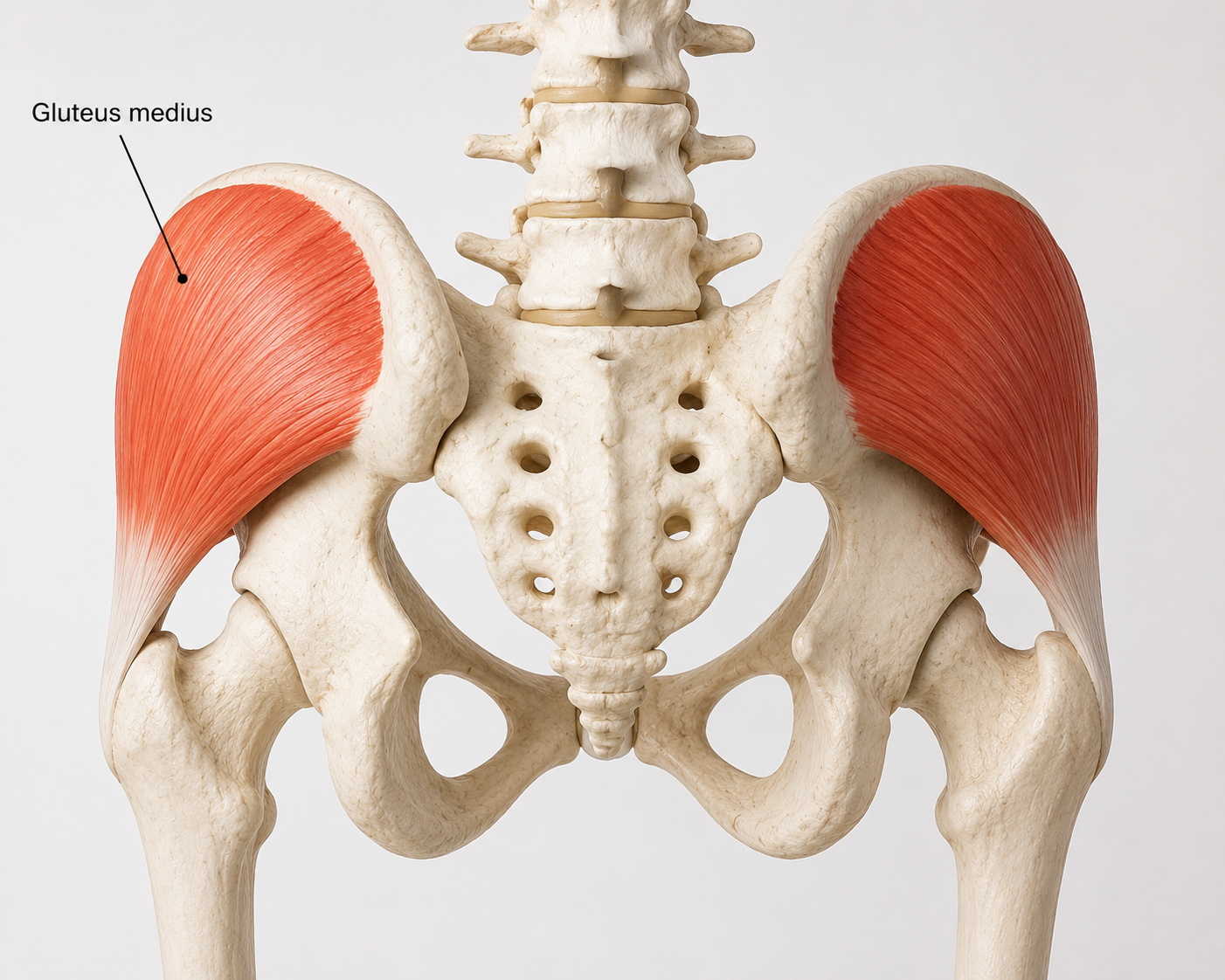
Glute medius anatomy — lateral hip stability and Trendelenburg pattern treated at Life in Motion Chiropractic Livonia MI

What Is the Modified Side Bridge with Hip Transition?

The Modified Side Bridge with Hip Transition is a two-phase lateral stability exercise that begins with a side-lying plank supported on one forearm and bent knees (the “modified” position), then adds a controlled hip abduction lift of the top leg as a transition — challenging both the lateral core and the glute medius in a single integrated movement.

The exercise earns its name from the combination of the modified side bridge (a side plank variation that reduces demand compared to the full straight-leg version, making it accessible for patients early in rehabilitation) and the hip transition (the controlled lifting and lowering of the top hip/leg that challenges the glute medius at the end range of its function).

The gluteus medius is the primary target — a fan-shaped muscle on the outer surface of the pelvis that stabilizes the hip during single-leg loading, controls pelvic drop during walking and running, and prevents the inward knee collapse that drives patellofemoral pain, IT band syndrome, and hip dysfunction. According to Physiopedia’s review of gluteus medius function, weakness of this muscle is among the most consistently identified contributors to lower extremity injury and low back pain — yet it is frequently undertrained because standard hip exercises preferentially recruit the gluteus maximus and TFL instead.

The modified side bridge position specifically isolates the glute medius by placing the hip in a position where the gluteus maximus and TFL are mechanically disadvantaged, making it one of the most targeted glute medius exercises available without equipment.

Primary muscles trained: Gluteus medius (hip abduction and pelvic stability), quadratus lumborum (lateral trunk stabilization), and obliques (anti-lateral-flexion core control). Secondary: gluteus minimus, TFL, hip abductor complex. The exercise trains all of these simultaneously in a gravity-loaded side-lying position that mimics single-leg stance demands.

Clinical note: This exercise sits in the middle of the lateral hip progression: it follows the Banded Clam (glute medius in a lower-demand non-weight-bearing position) and precedes single-leg balance and lateral band walking. For patients with Trendelenburg gait, IT band syndrome, or SI joint pain with lateral hip weakness, the modified side bridge with transition is often the single most important exercise in the program.

Common Conditions This Exercise Addresses

Hip & SI joint dysfunction
IT band syndrome
Low back pain with lateral weakness
Trendelenburg gait pattern
Knee valgus (inward collapse)
Patellofemoral pain syndrome
Hip impingement (FAI)
Athletic performance & running mechanics

Understanding the Exercise Structure

Phase 1 — The Bridge Hold

Modified side plank

Supported on one forearm and the bottom knee, with the top leg extended or stacked on the bottom knee. Hips lifted off the floor, body forming a straight line from head to knee. This isometric hold loads the lateral core and glute medius before any movement is added.

Phase 2 — The Hip Transition

Controlled top-leg abduction

While maintaining the bridge position and spinal alignment, the top leg is lifted (abducted) in a controlled arc and then lowered back to the starting position. This dynamic phase challenges the glute medius through its full abduction range while the lateral core maintains anti-lateral-flexion stability.
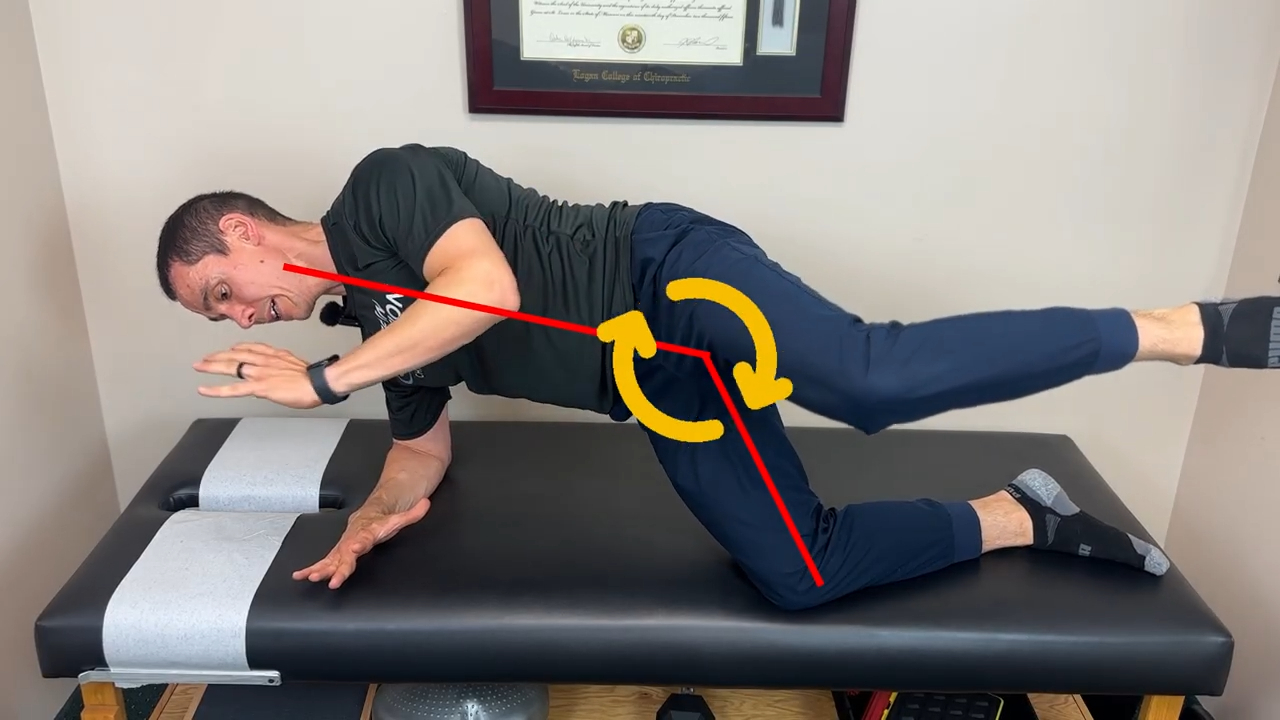
Dr. Dockery demonstrating the Modified Side Bridge with Hip Transition exercise — Life in Motion Chiropractic Livonia MI
Dr. Dockery demonstrating the modified side bridge position with hip transition at Life in Motion Chiropractic, Livonia MI

Step-by-Step Instructions

1

Set up the side-lying starting position

Lie on your side with your bottom forearm on the floor, elbow directly under your shoulder. Bend both knees to approximately 45–90 degrees, stacking the feet. Your body should be in a straight line from head to knees when viewed from behind. Place the top hand on your hip or in front of you for balance.

2

Lift into the modified side bridge

Press through the forearm and the bottom knee to lift the hips off the floor. The goal is a straight, neutral line from the head through the hip — avoid sagging the hips toward the floor or hiking them toward the ceiling. Feel the lateral core engage to maintain the position. Create light abdominal pressure before lifting to stabilize the spine.

3

Hold and establish the bridge position

Before adding the hip transition, hold the bridge position for 2–3 seconds to ensure spinal alignment and core engagement are established. The shoulder should be stacked over the elbow, the neck neutral, and the hips level. Do not proceed to the transition if you cannot maintain this alignment.

4

Perform the hip transition

While maintaining the bridge position and keeping the pelvis completely still, lift the top leg upward in a controlled abduction arc — approximately 30–45 degrees from the bottom leg. Keep the toes pointing forward (not toward the ceiling, which rotates the hip and recruits the TFL instead of the glute medius). Pause briefly at the top.

5

Lower the leg with control and repeat

Lower the top leg back to the starting stacked position slowly and under control — the eccentric lowering phase is as important as the lift for building glute medius strength and stability. Complete the prescribed repetitions on one side before switching to the other.

6

Lower the hips and rest between sets

After completing the set, lower the hips back to the floor with control. Do not collapse — lower slowly to maintain core engagement through the full set. Rest briefly before the next set or switching sides.

Most common compensation: Allowing the hips to sag or rotate during the leg lift. If the pelvis rotates backward when you lift the top leg, the hip flexors (not the glute medius) are doing the work. Keep the toes pointing forward throughout the lift, and if the pelvis moves during the transition, reduce the range of the leg lift until glute medius strength improves. The hip staying completely still is more important than lifting the leg high.

Key Technique Points

Elbow directly under the shoulder — a forward or backward elbow position shifts load away from the lateral core and onto the shoulder; stack them precisely
Hips level and still during the leg lift — the single most important cue; if the pelvis moves when the top leg lifts, the glute medius is not strong enough for that range yet — reduce the arc
Toes pointing forward throughout the transition — rotating the toes toward the ceiling internally rotates the hip and shifts the load from glute medius to TFL; keep them forward to target the intended muscle
Neck neutral, not dropped or extended — the head should remain in line with the spine throughout; looking down or craning upward indicates core fatigue and signals time to rest
Abdominal pressure maintained throughout the hold and transition — prevents the low back from overextending during the leg lift, which is a common secondary compensation when the glute medius fatigues
Slow and controlled eccentric lowering — lower the leg over 2–3 seconds; the eccentric phase builds lateral hip strength more effectively than fast repetitions

Watch the Technique

Modified Side Bridge with Hip Transition — Life in Motion Chiropractic

Dr. Dockery demonstrates the setup, bridge hold, hip transition arc, and how to identify and correct the most common compensations including hip rotation and pelvic drop during the leg lift.

Why This Exercise Works

Trains glute medius and lateral core simultaneously — the bridge hold loads the lateral core isometrically while the hip transition dynamically loads the glute medius, making this a more complete lateral stability exercise than either component alone
Isolates glute medius more effectively than many standard hip exercises — the side-lying abduction position mechanically reduces gluteus maximus and TFL contribution, ensuring the glute medius does the work rather than the stronger and more dominant surrounding muscles
Directly addresses Trendelenburg gait and pelvic drop — the bridge hold trains the lateral stability that prevents the contralateral hip from dropping during single-leg stance, which is the defining characteristic of Trendelenburg pattern and a major driver of IT band, knee, and back pain
No equipment required with clear progressions available — the modified (bent-knee) version is accessible for early rehabilitation; the exercise can be progressed to a full straight-leg side bridge, then to a side bridge with a resistance band around the knees for increased glute medius demand
Bridges the gap between the Banded Clam and weight-bearing lateral training — provides a more demanding glute medius stimulus than the clam while remaining accessible before single-leg and lateral band walking progressions are appropriate
Trains anti-lateral-flexion core stability — the lateral core (obliques and quadratus lumborum) must resist collapsing under gravity throughout the hold, building the trunk stability that protects the lumbar spine during real-world asymmetric loading

Frequently Asked Questions

My hip rotates when I lift my top leg. What am I doing wrong?
Hip rotation during the leg lift is the most common compensation and means the hip flexors — particularly the TFL — are substituting for the glute medius. This happens when the leg is lifted too high (beyond the range where glute medius can control the movement), when the toes rotate toward the ceiling (which internally rotates the hip and shifts the load), or when the glute medius is simply not yet strong enough to perform the movement without compensation. The fix is to reduce the range of the leg lift to where the pelvis can stay completely still, keep the toes pointing forward, and focus on feeling the outer hip engage rather than trying to reach a specific height.
How does this exercise differ from the Banded Clam?
The Banded Clam trains the glute medius in a side-lying position with the hips flexed, which is a lower-demand non-weight-bearing movement that is easier to learn and perform correctly. The Modified Side Bridge with Hip Transition adds the lateral core stability challenge of supporting your bodyweight in a side plank, loads the glute medius against gravity in a more functional plane, and requires significantly more full-body coordination. Most patients begin with the Banded Clam to establish glute medius activation and then progress to the Modified Side Bridge when they can perform the clam without TFL compensation.
I feel this in my hip flexor or outer thigh, not the glute. Why?
Feeling the TFL (outer thigh, toward the front of the hip) rather than the glute medius (outer hip, toward the back) usually means one of three things: the toes are rotating toward the ceiling, the leg is being lifted too high, or the pelvis is rotating backward during the lift. All three shift the load from the glute medius to the TFL. Try reducing the leg lift range to just 15–20 degrees, keep the toes firmly pointing forward, and focus on initiating the movement from the back of the outer hip rather than lifting the leg from the front. Dr. Dockery may also use manual cuing or repositioning during your visit to help establish correct activation before you perform the home version independently.
What does the Trendelenburg pattern have to do with my back or knee pain?
The Trendelenburg pattern — where the pelvis drops on the non-stance side during walking or single-leg activities — is caused by glute medius weakness on the stance side. When the pelvis drops, the lumbar spine compensates with lateral flexion, increasing compressive load on the facet joints and disc on the side of the pelvic drop. At the knee, pelvic drop combined with hip internal rotation causes the knee to collapse inward (valgus), increasing patellofemoral stress and IT band tension. Strengthening the glute medius through exercises like this one directly corrects the Trendelenburg pattern and reduces the downstream effects on the knee and low back.
Can I do this with hip impingement or a labral issue?
The modified side bridge with hip transition is generally well tolerated in hip impingement and labral presentations because the hip remains in a neutral to slightly extended position throughout — avoiding the hip flexion angles that typically provoke FAI symptoms. However, if the bridge position itself creates groin or deep hip pain, the exercise may need to be modified or temporarily replaced. Let Dr. Dockery know if any position reproduces your specific hip symptoms so the exercise can be adjusted appropriately.
How does this fit into the broader lateral hip program?
The lateral hip rehabilitation progression at Life in Motion typically follows this sequence: Banded Clam (glute medius activation in a low-demand non-weight-bearing position) → Modified Side Bridge with Hip Transition (glute medius + lateral core in a moderate-demand side-lying position) → Banded Glute Bridge (glute medius + glute max in a supine position) → Single-leg balance and lateral band walking (weight-bearing). Many patients perform two or three of these in the same session as the glute medius rehabilitation advances.

This content is for educational purposes only. Stop if symptoms worsen or pain develops, and consult Dr. Dockery if you are unsure whether this exercise is appropriate for your condition.

Build Lateral Hip Strength in Livonia, MI

The Modified Side Bridge with Hip Transition is most effective as part of a complete glute medius and lateral stability program. Dr. Dockery serves patients throughout Livonia, Farmington Hills, Redford, Plymouth, and greater Wayne County.

Or call us at 734-427-6333