
Rocabado 6×6
TMJ & Jaw Mobility Exercise Program
A foundational TMJ rehabilitation routine prescribed by Dr. Dockery that combines six targeted exercises for jaw mechanics, tongue posture, diaphragmatic breathing, cervical alignment, and shoulder stabilization — performed six times daily to restore coordinated jaw-neck-shoulder function and reduce TMJ symptoms.
What Is the Rocabado 6×6 Program?
The Rocabado 6×6 is a foundational TMJ rehabilitation exercise program developed by Dr. Mariano Rocabado, a physical therapist and pioneer in craniocervical and temporomandibular rehabilitation whose work remains the clinical gold standard for conservative TMJ management. The program consists of six coordinated exercises targeting different aspects of jaw-neck function, performed six repetitions each, six times per day.
What makes the Rocabado program distinctively effective is that it does not treat the jaw in isolation. The six exercises address the jaw, the cervical spine, the breathing system, the tongue, and the shoulder girdle as an integrated functional unit — because these structures are anatomically and neurologically interconnected. Chronic jaw tension, for example, is almost always associated with forward head posture and impaired diaphragmatic breathing, neither of which jaw exercises alone can address.
According to Mayo Clinic’s overview of TMJ disorders, conservative self-care and targeted exercise are among the most effective first-line treatments for TMJ dysfunction — and the Rocabado 6×6 is precisely the type of structured, multidimensional approach that clinical guidelines recommend.
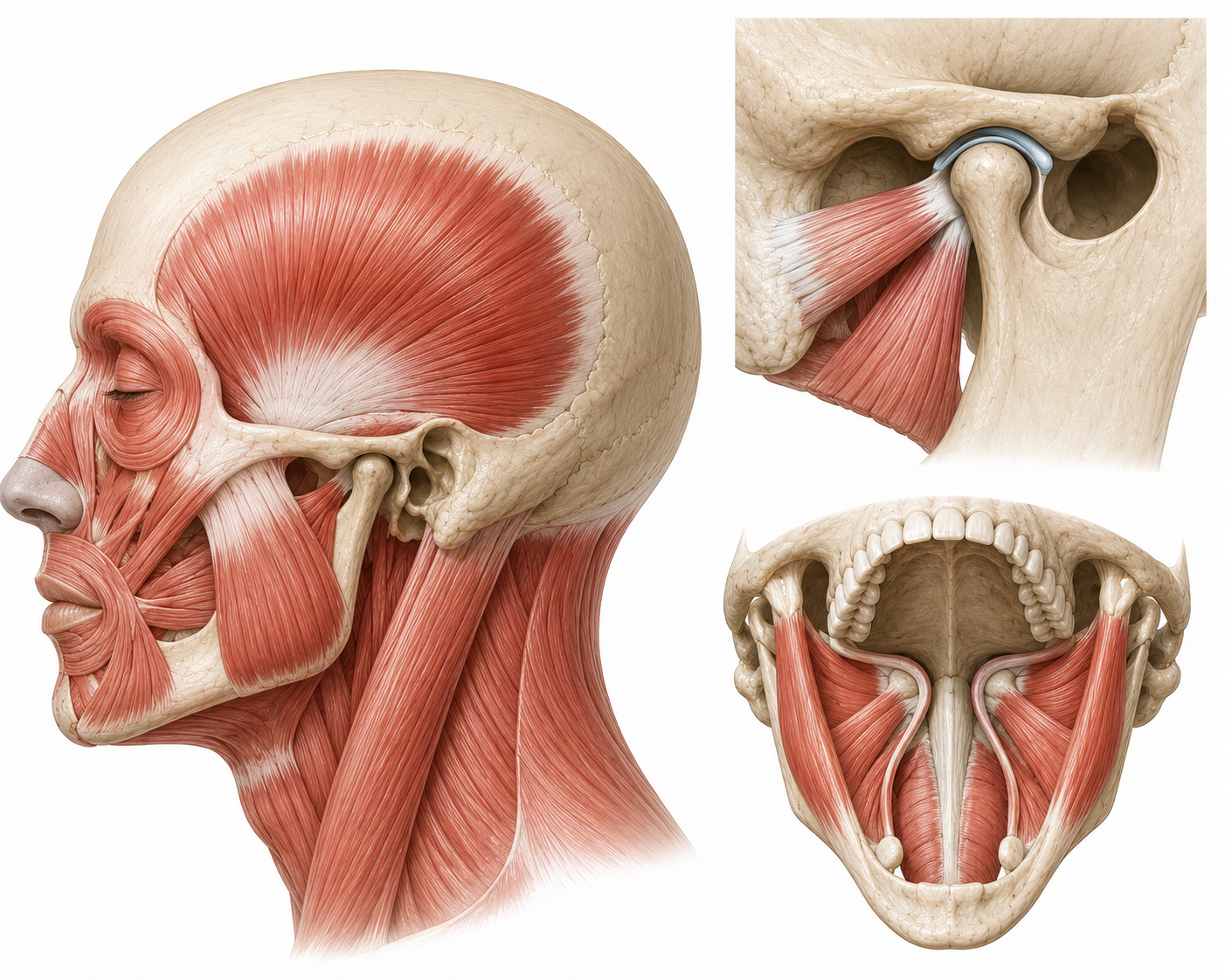
Structures addressed: Temporomandibular joint (disc, capsule, and condyle mechanics), masseter and pterygoid muscles (jaw closers and deviators), suprahyoid and infrahyoid muscles (jaw openers and throat stabilizers), cervical deep flexors (head posture), diaphragm (breathing mechanics), and lower trapezius/rhomboids (shoulder blade posture). The program targets all of these simultaneously through the six exercises.
Clinical note: The Rocabado 6×6 is typically the foundational home exercise program for patients presenting with TMJ dysfunction, jaw clicking, jaw pain, or temporomandibular-related headaches. Dr. Dockery will individualize the program based on your specific presentation — some patients begin with a subset of the exercises while others add specific modifications for disc displacement, bruxism, or cervical involvement. See also: TMJ Dysfunction Treatment at Life in Motion.
Common Conditions This Program Addresses
Understanding the 6×6 Protocol
Why 6 reps, 6 times a day?
Important before starting: The effectiveness of the Rocabado program depends on posture during each exercise. All six exercises should be performed seated with the head stacked directly over the shoulders — not in forward head posture. If you are working at a desk, take a moment to sit back, lengthen the neck, and draw the chin back slightly before beginning. Performing the exercises in forward head posture reduces their therapeutic benefit and can reinforce the dysfunction they are designed to correct.
Each Exercise Explained
Place the tip of the tongue on the spot just behind the upper front teeth — the small bumpy ridge called the incisive papilla, sometimes called the “N” position or the “tongue spot.” Press the tongue gently against this position and make a clicking sound by dropping the jaw while keeping the tongue tip in contact. Repeat 6 times.
- The click serves as proprioceptive feedback — confirming the tongue has left the correct resting position
- The resting tongue posture (tip behind upper front teeth, body of tongue on the roof of the mouth) is the single most important postural habit for long-term TMJ health
- Tongue resting on the floor of the mouth (the most common alternative) creates downward pressure that destabilizes the mandible and increases TMJ loading
- After each click, consciously return the tongue to the resting spot before the next rep
With the tongue resting on the roof of the mouth and lips lightly closed, breathe slowly through the nose six complete breath cycles. Direct each inhale into the abdomen — let the belly expand first, then the lower ribs. The shoulders should remain relaxed and still; if they rise with each breath, the breath is chest-dominant rather than diaphragmatic.
- Mouth breathing is consistently associated with TMJ dysfunction — it forces the tongue to the floor of the mouth, promotes forward head posture, and increases jaw muscle tension
- Nasal breathing filters and humidifies air, supports proper tongue posture, and activates parasympathetic (calming) nervous system activity that directly reduces jaw muscle tension
- The diaphragmatic component connects to the 90/90 Breathing Exercise principles — breath mechanics affect posture from the pelvis through the cervical spine to the jaw
- Breathe at a natural, unhurried pace — approximately 4–5 seconds inhale, 4–5 seconds exhale
With the tongue on the roof of the mouth (maintaining contact throughout the movement), slowly open the mouth until the tongue naturally loses contact with the palate — this is approximately the maximum opening that can occur without the tongue dropping and without the jaw deviating to one side. Hold briefly, then close slowly. Repeat 6 times. Do not force the jaw open beyond the point where the tongue releases.
- The tongue-on-palate constraint limits opening to the range where the condyles translate properly without excessive anterior disc displacement
- If the jaw deviates to one side during opening, it signals asymmetric muscle tension or disc displacement on the ipsilateral side — note this for Dr. Dockery
- Avoid placing fingers in the mouth to force opening — the Rocabado method uses muscle relaxation rather than passive stretching
- If clicking occurs during this movement, do not try to open through or past the click — stop at the onset of the click, hold briefly, and return
Using one or both hands, apply gentle resistance to the jaw in multiple directions while the jaw attempts (but does not succeed) to move. Common directions include: press upward against the chin while slightly resisting jaw opening (resisted opening); press lightly against the side of the chin while resisting lateral deviation; and press down gently while resisting jaw closing. Maintain each isometric hold for 3–5 seconds per direction, 6 total repetitions distributed across the directions.
- The isometric loading activates the masticatory muscles at minimal joint stress — building muscle tone without increasing TMJ compression
- Keep resistance gentle — no more than about 15–20% of maximum force; the goal is neuromuscular activation, not strength training
- Maintain good head posture throughout — do not jut the chin forward during any direction
- Stop if any direction reproduces sharp pain or clicking that was not present before
Sit tall with ears stacked over shoulders. Without tilting or turning the head, perform a small nodding motion — as if very slowly saying “yes” — by gently tucking the chin downward while keeping the back of the head tall. This is a small motion (approximately 10–15 degrees) at the upper cervical joints, not a large neck flexion. Hold the slight tucked position for 3–5 seconds, then return to neutral. Repeat 6 times.
- This exercise directly addresses the upper cervical joint mobility and deep cervical flexor strength that are consistently impaired in patients with both forward head posture and TMJ dysfunction
- Forward head posture increases the load on the jaw by shifting the mandible forward relative to the skull — correcting it reduces baseline TMJ compressive stress
- Do not push the chin dramatically into the neck — the motion is subtle; the emphasis is on elongating the back of the neck, not collapsing the front
- Can be combined with the TWL Exercise and shoulder blade retractions for a comprehensive cervical-shoulder reset
Sit or stand tall. Gently draw the shoulder blades back and slightly downward — think of sliding them toward the spine and slightly toward the back pockets. Hold 3–5 seconds, then release slowly. Repeat 6 times. Maintain a relaxed neck throughout; the motion should come from the mid-back muscles, not from pulling the shoulders toward the ears.
- Rounded shoulders and forward head posture are functionally linked — correcting shoulder blade position automatically improves the ability to maintain head-over-shoulders alignment
- This exercise trains the mid and lower trapezius, which are the same muscles targeted by the TWL Exercise
- It is the final step in the Rocabado sequence because it consolidates the postural corrections established by the previous five exercises into a stable end position
- Avoid pinching the shoulder blades together aggressively — a controlled 30–40% retraction with sustained hold is more beneficial than a maximal squeeze
Key Points for All 6 Exercises
Watch the Technique
Why This Program Works
Frequently Asked Questions
This content is for educational purposes only. Stop any exercise that causes sharp pain or new clicking patterns, and consult Dr. Dockery before modifying the program. TMJ symptoms should be evaluated by a qualified clinician before beginning a home exercise program.
Related condition
Jaw pain that keeps coming back?
The Rocabado 6×6 is a maintenance routine — it works best once the underlying cause of the jaw dysfunction has been identified. Clenching, disc displacement, forward head posture and airway issues all produce similar symptoms but need different treatment.
How we treat TMJ dysfunctionIn the Livonia area? A jaw and airway assessment tells you which pattern you’re actually dealing with. Book an evaluation.
TMJ & Jaw Pain Treatment in Livonia, MI
The Rocabado 6×6 is most effective when customized to your specific TMJ presentation and combined with chiropractic care. Dr. Dockery serves patients throughout Livonia, Farmington Hills, Redford, Plymouth, and greater Wayne County.