Ulnar Nerve Floss | Ring & Pinky Finger Numbness Relief | Life in Motion Chiropractic Livonia MI

Ulnar Nerve Floss
for Ring & Pinky Finger Numbness & Tingling

A neurodynamic mobilization technique prescribed by Dr. Dockery to reduce irritation of the ulnar nerve along its path from the neck through the elbow (cubital tunnel) and wrist — relieving the numbness, tingling, and weakness affecting the forearm, ring finger, and pinky.
2–3 min, 2–3× daily No equipment needed Beginner-friendly Livonia, MI
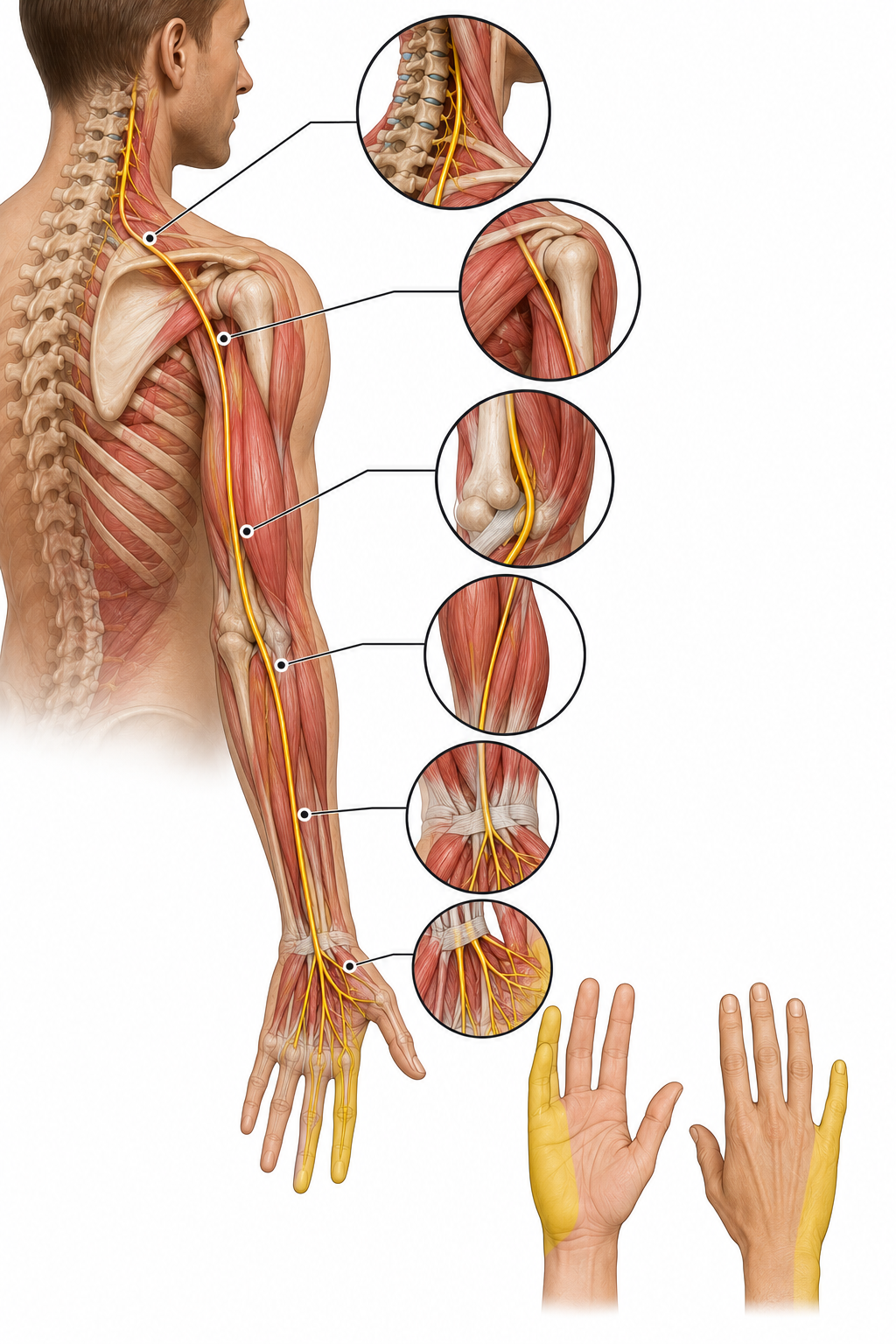
Ulnar nerve path and hand innervation — ring finger and pinky numbness treated at Life in Motion Chiropractic Livonia MI

What Is the Ulnar Nerve Floss?

The Ulnar Nerve Floss is a neurodynamic mobilization exercise — a gentle technique that moves an irritated or compressed nerve back and forth through the surrounding tissues to reduce inflammation, improve nerve mobility, and restore normal neural conduction. Unlike stretching a muscle, nerve flossing works by alternately tensioning and releasing the nerve from opposite ends, creating a “flossing” motion that helps the nerve glide more freely through the structures around it.

The ulnar nerve originates from the C8 and T1 nerve roots in the lower cervical spine, travels through the brachial plexus, passes behind the medial epicondyle at the elbow (the “funny bone” groove), continues through the Guyon’s canal at the wrist, and terminates in the ring finger (4th digit) and pinky finger (5th digit). According to NIH StatPearls on ulnar nerve entrapment, compression most commonly occurs at the elbow (cubital tunnel syndrome) or wrist (ulnar tunnel syndrome), and neurodynamic exercises are a well-supported conservative intervention for both.

The floss exercise prescribed here oscillates the arm between two positions — one that tensions the ulnar nerve from the hand end, and one that tensions it from the neck end — creating a gentle back-and-forth mobilization that reduces adhesion and improves nerve health throughout its entire length.

Ulnar nerve path: Cervical spine (C8–T1) → brachial plexus → inner upper arm → medial elbow (cubital tunnel / “funny bone”) → inner forearm → wrist (Guyon’s canal) → ring finger and pinky. Compression or irritation at any point along this route can produce the same symptoms in the hand and fingers.

Clinical note: Ulnar nerve symptoms are commonly misattributed to carpal tunnel syndrome, which affects different fingers (thumb through ring finger via the median nerve). If your numbness affects the ring and pinky fingers, the ulnar nerve is likely involved. Dr. Dockery will determine the exact site of compression — cervical spine, elbow, or wrist — and prescribe the appropriate nerve floss and manual treatment. See also: Median Nerve Floss and Radial Nerve Floss.

Common Conditions This Exercise Addresses

Ring & pinky finger numbness
Cubital tunnel syndrome
Ulnar nerve entrapment at wrist
“Funny bone” nerve irritation
Forearm weakness & grip issues
Cervical radiculopathy (C8–T1)
Symptoms from prolonged elbow flexion
Keyboard/desk worker nerve symptoms

Step-by-Step Instructions

The nerve floss should produce no more than a mild, transient stretch or tingling sensation during the exercise. If symptoms worsen, become sharp, or spread further down the arm, stop immediately and consult Dr. Dockery before continuing. Never push into pain.

Position 1 — Tension from the hand end

The “OK sign over the eye” position

  • Make an “OK” sign with your thumb and index finger on the affected side
  • Flip the OK sign upside down and bring it up to cover your eye — the circle of your fingers rests over the eye like a monocle
  • Laterally flex your head (ear toward shoulder) toward the affected side
Position 2 — Tension from the neck end

The “handshake reach” position

  • Release the OK sign and lower the arm, reaching forward as if offering a handshake — arm extended in front, palm facing inward
  • Laterally flex your head (ear toward shoulder) away from the affected side
Oscillate smoothly between Position 1 and Position 2 — the movement should be rhythmic and controlled, not jerky or forced
Perform 15 repetitions per set, 2–3 sets, 2–3 times daily — or as specifically directed by Dr. Dockery
Stay seated and relaxed throughout — tension in the shoulder or neck will reduce the effectiveness of the floss
Mild, transient tingling is expected and acceptable — lasting or worsening symptoms are not, and the exercise should be stopped
Perform on the affected side only unless Dr. Dockery has specifically prescribed bilateral work

Watch the Technique

Ulnar Nerve Floss — Life in Motion Chiropractic

Dr. Dockery demonstrates the two-position ulnar nerve floss technique, head lateral flexion cues, and how to identify an appropriate level of sensation during the exercise.

Why This Exercise Works

Mobilizes the nerve throughout its full length — the alternating tension pattern moves the ulnar nerve from both ends simultaneously, addressing restriction at the elbow, wrist, and cervical spine in a single exercise
Reduces intraneural edema and adhesion — nerve flossing promotes fluid movement within and around the nerve sheath, reducing the swelling and scar tissue that develop in response to compression or entrapment
Supported by clinical research — neurodynamic exercises for cubital tunnel syndrome are backed by research showing meaningful reduction in numbness, tingling, and grip weakness when combined with other conservative care
Addresses the entire nerve tract — because ulnar nerve symptoms can originate from the neck, elbow, or wrist, the two-position floss is designed to mobilize the nerve across all three potential sites of compression simultaneously
Simple and equipment-free — takes under 3 minutes and can be performed anywhere, making consistent daily compliance straightforward
Complements chiropractic and manual therapy — nerve flossing performed between visits helps maintain the neural mobility achieved through hands-on treatment and accelerates recovery

Frequently Asked Questions

How do I know if my symptoms are from the ulnar nerve vs. carpal tunnel?
The key difference is which fingers are affected. Carpal tunnel syndrome compresses the median nerve and causes numbness and tingling in the thumb, index, middle, and half of the ring finger. Ulnar nerve entrapment causes numbness, tingling, and weakness in the ring finger and pinky (4th and 5th digits). If you also notice weakness in your grip or difficulty with fine motor control — especially tasks requiring the pinky and ring finger — ulnar nerve involvement is more likely. Dr. Dockery will assess both possibilities and identify the correct nerve and the location of compression before prescribing the appropriate floss.
Where is the ulnar nerve most commonly compressed?
The two most common sites are the cubital tunnel at the medial elbow (where the nerve wraps around the inside of the elbow — this is what you hit when you bang your “funny bone”) and the Guyon’s canal at the wrist. Cubital tunnel is significantly more common and is frequently aggravated by prolonged elbow flexion during sleep, driving, or phone use. The cervical spine (C8–T1 nerve roots) can also contribute to symptoms that travel the full length of the ulnar nerve’s path.
How much tingling is normal during the exercise?
A mild, brief tingling or stretch sensation during the oscillation is expected and is a sign the nerve is being mobilized. This should resolve quickly when you stop. What you should not experience is sharp pain, significant increase in your current symptoms, or tingling that persists well after completing the set. If symptoms worsen or the tingling feels different from your usual symptoms, stop and report this to Dr. Dockery.
My symptoms are worse in the morning or after sleeping with my elbow bent. What does that mean?
This is a classic presentation of cubital tunnel syndrome. When the elbow is held in a flexed position during sleep, the ulnar nerve is stretched around the medial epicondyle for extended periods, increasing compression and producing morning symptoms. Strategies that help include keeping the elbow straight during sleep (a towel wrapped loosely around the elbow prevents full flexion), avoiding leaning on the elbow, and performing the nerve floss first thing in the morning when symptoms are typically at their worst.
How does this differ from the radial and median nerve floss exercises?
Each floss exercise is designed specifically for one nerve’s anatomical path and the positions that tension it. The Radial Nerve Floss targets the radial nerve (thumb and dorsal hand), the Median Nerve Floss targets the median nerve (carpal tunnel / thumb through ring finger), and the Ulnar Nerve Floss targets the ulnar nerve (ring and pinky). The “OK sign over the eye” hand position in this exercise specifically places the ulnar nerve in tension by flexing the elbow and wrist in a way that stretches the nerve through the cubital tunnel. Patients with cervicobrachial symptoms involving multiple nerve distributions may be prescribed more than one floss technique.
Can nerve flossing worsen my symptoms?
When performed correctly and within a comfortable intensity, nerve flossing should not worsen symptoms. However, if the nerve is severely inflamed or acutely compressed, even gentle mobilization can temporarily increase irritation. This is why intensity is carefully prescribed — if you are in an acute flare or have significant nerve inflammation, Dr. Dockery may recommend a gentler approach called nerve “sliding” (tension from only one end at a time) before progressing to full flossing. Always communicate any change in symptoms between visits.

This content is for educational purposes only. Stop if symptoms worsen or pain develops, and consult Dr. Dockery if you are unsure whether this exercise is appropriate for your condition. Nerve symptoms should always be evaluated by a qualified clinician before beginning a home exercise program.

Find Relief from Nerve Symptoms in Livonia, MI

Ulnar nerve symptoms respond well to a combination of chiropractic care, neurodynamic exercise, and addressing the underlying cause of compression. Dr. Dockery serves patients throughout Livonia, Farmington Hills, Redford, Plymouth, and greater Wayne County.

Or call us at 734-427-6333